







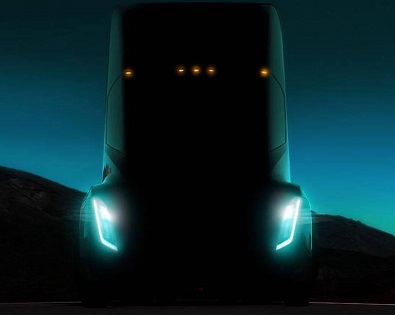
 Electric trucks have had a buzz around them for a while now, but until last week the public has been largely in the dark about any specifics. That all changed on Tuesday when Cummins unveiled a Class 7 semi that’s fully electric with no diesel engine at all.
Cummins is calling their new creation AEOS, after one of the horses who pulled the chariot of Helios, the Greek sun god. With a range of 100 miles, it’s designed for short hauls. It will haul 44,000 pounds of freight. While it will take about an hour to charge the battery, Cummins expects that to drop to 20 minutes by 2020.
It currently relies on low-resistance tires and regenerative braking to achieve that 100-mile range, but Cummins claims that the range can be extended using an additional battery.
Since Cummins is known an engine manufacturer, they will not be creating the whole rig. Instead, they partnered with Roush Industries to help develop the truck. Cummins plans on supplying the battery and driveline system and having other companies will assemble the trucks. Production is expected to begin as early as 2019.
The timing of the AEOS unveiling is important since they’ve just narrowly beaten Tesla who is planning on unveiling its own all-electric big rig sometime in September.
While the details of the Tesla truck are not yet official, Tesla owner Elon Musk has set expectations fairly high.
“A lot of people don’t think you can do a heavy-duty, long-range truck that’s electric, but we are confident that this can be done,” Musk said during a shareholders meeting.
Unless Tesla has had a huge breakthrough in battery technology however, the range will likely be limited to 300 miles. A Carnegie Mellon study estimated that to be the current limit of an electric semi, saying that in order to achieve a range of 600 miles, the battery would have to weigh 14-tons.
According to a report from Reuters, the truck will probably be just a day-cab. But they expect that the truck will be used for regional trips, not only local ones. If the range is what they’re expecting, that’s shouldn’t be a problem. According to the CTO of Fleet Complete, a truck and fleet analysis company, roughly 30% of all U.S. trucking jobs are regional trips requiring trucks to travel between 100 and 200 miles daily. “As long as (Musk) can break 200 miles, he can claim his truck is ’long haul’ and he will be technically right,” the CTO told Reuters.
Tesla seems to be going all-in on electric only, but Cummins still has faith that diesel engines will remain an important part of commercial trucks for the near future. As such, Cummins says that they plan to offer an extended-range model that uses a diesel engine to charge the battery pack. That would allow the truck to get 300 miles of range and cut emission by as much as 50 percent.
Cummins is betting that even if the technology for electric-only trucks is there, the industry will need a transition period. In an interview with Forbes, Cummins’ CEO estimated that “even if the electrified power train replaces the internal combustion engine completely, that’s still a 20- to 25-year transition period customers have to manage through.”
Source: truckinginfo, cnet, jalopnik, fleetowner, fleetowner, overdrive, truckinginfo




Battle to see who puts truckers out of a job first. Great! Always wanted to go on wellfare. NOT! Government already broke and you want to put over 25 million more unemployed? Yes, 25 million. Not only truckers but all those people we indirectly employ to help and serve us. Rich don’t care. ATA don’t care either. Wait, same group. Only way we as truckers survive is to band together NOW. We have little time left until we are ALL screwed.
Wrong article, bub. You should read the article before commenting. This article is about electric vehicles not autonomous ones.
Even automatically used truck’s have to be maned by a driver
Your also about John he needs to read the article before he sticks his foot in his mouth
Without electric truck we will run out of oil faster. Were in a transition of technology. Same job different fuel source. Electric trucks dont drive well in winter conditions, but they will probably decide to build more rail and distribution depots. Than have more short range drivers for the last 200 miles or so. Its a technology transition and the story that cummins is competing with tesla is good, more choice for truck buyers. Also a new transition into electric mechnic job positions to replace older jobs.
Sorry you are wrong on so many levels…First the government is not broke and never will be….the have the power of taxation and all that they ever need to do is tax the people who have the money..The money never goes away it’s always still there…second this article that either you never even red or can’t understand is NOT About Driver-less Trucks..It about Trucks without fuel…
If you want to save oil just stop idling your trucks and fossil oil resources will last decades longer.
This concept puts more money back into o/o hands. Who’s reading this? I for one am excited about such a transition and am looking forward to break from petroleum dependency.
The lack of a storage media that can last 1000 miles and be replenished in 30 minutes makes commercial long haul electric trucks unviable for use. The only reason the electric vehicle fad exists is because of heavy subsidies from the US taxpayer. If the subsidies were removed then the industry would collapse. I don’t want it to collapse, what I want is for tax money to be spent improving roads and not supporting a concept that caters to people who can afford a $90,000 car that can only go 150 miles before the driver starts to sweat. I’ve seen many a tesla dead on I80 trying to reach the charger by the Bloomsburg TA.
What the industry needs is in my estimate 300/300 hybrid truck.
300 hp generator + 300 kWH battery to drive 1000 hp electric drive, ideally 500 hp on each axle. Electric climate control that can be equally used in motion or while parked.
You should check out the Nikola One
Everyone seems to be excited about the introduction of all these electric vehicles and about how much fossil fuel that won’t get burned in the future…
Problem is, that that electricity has to come from somewhere and the current method of production is to burn fossil fuels to get it… so where is the advantage?
Another problem is that while you may look at this and think you are going to save a ton of cash at the pump, you’re going to end up spending it on other things… like infrastructure to be able to charge the units and the cost of the electricity you’re going to have to buy to actually do the charging. A few months ago (I can’t remember exactly when) I watched a news bit on what it takes to have electric cars entering the marketplace… from an owner’s standpoint. Obviously, your home needs a charging station or you need an adaptor to plug into a regular wall plug. (super slow apparently) All fine and dandy until the utility company rep comes on and explains that just about every residential neighbourhood in North America is wired to handle just the daily operation of the houses within them with a little “wiggle room” for peak capacity events like hot summers where people go nuts with the air conditioners. The average neighbourhood can apparently handle maybe 2 or 3 electric cars before the circuits start to blow out. This means that the entire North American power grid will need to be upgraded to handle substantially more power. From the high voltage lines that bring the power from the generating stations to the city or town, the cables that bring it from the substations to the neighbourhood transformers, and each and every cable that brings it to each and every house. Now, who do you think is going to be paying for that? And how long before this needs to be done?
Electric is a wonderful idea… but can the infrastructure support it?
solar power station at your home..Charger will have inverter
technology that is greater capacity than the vehicle battery.
Not cheap…but the future never is.